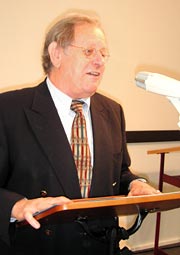
Dr. John (Jack) F. Haught is a Roman Catholic theologian and the Landegger Distinguished Professor of Theology at Georgetown University. His area of expertise is systematic theology, with a special interest in issues of science, cosmology, ecology, and reconciling evolution and religion. He graduated from St. Mary's Seminary and University in Baltimore and subsequently received his PhD in theology from The Catholic University of America in 1970 and was the winner of the 2002 Owen Garrigan Award in Science and Religion and the 2004 Sophia Award for Theological Excellence. He was the chair of Georgetown's theology department between 1990 and 1995.
Haught, who established the Georgetown Center for the Study of Science and Religion, is the author of several important books on the creation-evolution controversy, including Deeper Than Darwin: The Prospect for Religion in the Age of Evolution, God After Darwin: A Theology of Evolution, and Responses to 101 Questions on God and Evolution. A theistic evolutionist, he sees no conflict between science and religion because they explore different levels of explanation. Therefore, "Science and religion cannot logically stand in a competitive relationship with each other."
The Gift of an Image
Christian faith is a response to the "revelation" of a divine mystery. It is the obedient embracing of a promise by God given to the world first through Israel and then through Jesus Christ and the Church. The word "revelation" is derived from the Latin word revelare (literally, to remove a veil). And although we must avoid basing a theology of revelation on the etymology of this term, we may at least say that in some sense "revelation" entails a disclosure. It is the "word" of God, the communication of a promising and saving mystery. In the final analysis, the substance of the revelatory word of promise is the gift of God’s own self to the world.
In traditional Catholic systematic theology, revelation is generally understood as the locutio Dei, the "speech of God." Although to Augustine it implied a divine "illumination" of our souls, it has usually meant God’s passing on to us propositional truths to which we would otherwise have no access. A standard traditional definition of revelation is "the communication of those truths which are necessary and profitable for human salvation . . . in the form of ideas."(From P. Schanz’s Apologie des Christentums (1905), quoted by Werner Bulst, Revelation. trans. by Bruce Vawter (New York: Sheed & Ward, 1965) 18.) Alternatively, revelation has been defined typically as "direct discourse and instruction on the part of God." It is "an act by which God exhibits to the created mind his judgments in their formal expression, in internal or external words."(B. Goebel, Katholische Apologetik (1930), as quoted by Bulst, 18.)
To many believers, such definitions are still sufficient. But for some time now, Christian theologians have questioned the adequacy of this rather "propositional" understanding of revelation. In contemporary theology, both Catholic and Protestant, the concept of revelation has come to refer more radically to the gift of God’s own self to the world. Although even the First Vatican Council stated that it has pleased God to reveal himself and the eternal decrees of his will to the human race [Denz. 1785],(Bulst, 23) the Protestant theologian Paul Althaus is quite correct in pointing out that Catholic theology of the past has had an overly intellectualized and depersonalized notion of revelation.(Bulst, however, thinks that Althaus’ observations are unjustified[22]) Today, this situation has dramatically changed. A new reading of the Bible, the Church Fathers and other theological sources, and perhaps especially the documents of the Second Vatican Council have been moving Catholic theology toward a new consensus about the nature of revelation. More and more theologians propose that the content of revelation is fundamentally the very reality of the divine self. In this book, we shall explore some of the implications of this development in the theology of revelation.
In the Bible, God’s self-revelation comes in the form of promise.(From the perspective of biblical theology it was especially Gerhard von Rad who brought this theme of revelation as promise to the front. Old Testament Theology, 2 vols., trans. by D. M. 0. Stalker (New York: Harper & Row, 1962-65). But it has been especially Jürgen Moltmann who has made it a central theme in contemporary systematic theology. Theology of Hope, trans. by James W. Leitch (New York: Harper & Row, 1967). Although the formal theological notion of revelation is not the subject of explicit discussion in the Scriptures, it is substantively present in the many shapes that God’s promise takes in the biblical stories. One specific type of revelatory promise, that of Jesus’ post-Easter appearances to his disciples, is the foundation of Christian faith and hope.(Moltmann, Theology of Hope, 139-229.) Christians believe that a special "promissory" revelation from God lies at the origin of their common faith. Promissory events in its history have summoned the Christian community, the Church, into being. The revelation of a great promise is what gives the people of God their sense of origin, identity, and future destiny. And for all who place their trust in it, this revelation illuminates reality in an ever new and surprising way.
Christianity, however, is not the only religious tradition based on a sense of revelation. Indeed, in a broad sense at least, most religions may be interpreted as responses to the revelatory disclosure of a sacred mystery. Any Christian reflection on the idea of revelation, such as we shall undertake in this book, now has to be situated in a context shaped by our growing appreciation of the plurality of religious revelations. However distinct Christian revelation may appear to be, it is still linked to the long human search for meaning and mystery upon which our earliest human ancestors embarked as long ago as the Old Stone Age. We cannot leave out of our considerations the broader religious context from which Christianity historically emerged and within which it now has to understand itself. In order to appreciate any possible uniqueness of a Christian revelation we must seek to locate it within the context of the wider world of religion.
The Problem of Revelation
However, we cannot ignore the fact that the very possibility of any kind of religious revelation has been seriously challenged by modern thought. While we shall be concerned in this book primarily with the nature of revelation, we must also honestly acknowledge that today there is much doubt about whether what we call "revelation" has actually happened and if the notion has anything to do with reality. In former ages, divine revelations were seemingly commonplace. Even the dreams of ordinary people were interpreted as messages from the gods. Shamans, seers, prophets, ecstatics, and other mediators of the "other world" abounded. Cultures devoid of a sense of revelatory phenomena were rare indeed. But the assumption that nature, history, and human consciousness can be abruptly perforated by sacral manifestations from a realm beyond the ordinary has been rejected by modern skepticism. Even though popular culture is still open to supernormal appearances from the "beyond," many sincere seekers of truth now scoff at the very idea of revelation. That a sacred or mysterious realm of alternative reality can intervene in and startlingly illuminate our profane or secular experience seems unbelievable to many. And that we should base our lives on the alleged authority of any such apparently extraneous intrusions, rather than on empirically and publicly testable experience available to all, often seems preposterous.
The following quotation from Paul Davies, a well-known contemporary scientist and writer, illustrates the negative light in which the idea of revelation is often perceived today:
The scientist and theologian approach the deep questions of existence from utterly different starting points. Science is based on careful observation and experiment. . . .
In contrast, religion is founded on revelation and received wisdom. Religious dogma that claims to contain an unalterable Truth can hardly be modified to fit changing ideas. The true believer must stand by his faith whatever the apparent evidence against it. This ‘Truth’ is said to be communicated directly to the believer, rather than through the filtering and refining process of collective investigation. The trouble about revealed ‘Truth’ is that it is liable to be wrong, and even if it is right other people require a good reason to share the recipients’ belief. (Paul Davies, God and the New Physics [New York: Simon & Schuster, 1983] 6.)
Even if Davies’ position is an enormous caricature, it shows clearly that in the arena of public and, especially, academic discourse we can no longer take the idea of revelation for granted. Revelation has become a problematic notion even to some theologians. Indeed, academic theologians have at times proposed that we drop it altogether. It seems to them, no less than to scientific thinkers, to be magical and superstitious. Stanley Hauerwas, a widely respected contemporary theologian, writes: "The very idea that the Bible is revealed . . . is a claim that creates more trouble than it is worth."(As quoted by Ronald Thiemann, Revelation and Theology (Notre Dame: University of Notre Dame Press, 1985) 1. And Ronald Thiemann, who disagrees, nevertheless observes that Hauerwas’ statement
captures well a growing consensus among contemporary theologians. . . Despite the prominence of doctrines of revelation in nearly every modern theology written prior to 1960, very little clarity has emerged regarding the possibility and nature of human knowledge of God. Indeed, most discussions of revelation have created complex conceptual and epistemological tangles that are difficult to understand and nearly impossible to unravel. A sense of revelation-weariness has settled over the discipline and most theologians have happily moved to other topics of inquiry.(Ibid.)
Both Hauerwas and Thiemann are speaking, though with differing convictions, out of a Protestant context. Catholic theology (as well as most Protestant theology), on the other hand, has not experienced the same degree of disillusionment with the notion of revelation. In fact, it has kept the theme very much at the forefront of its systematic theology. One of the documents of the Second Vatican Council, Dei Verbum, was devoted especially to the topic of revelation, and it has encouraged theologians to deepen and broaden their interpretations of it.
But is this persistence in affirming the importance of revelation theology perhaps another sign of Catholic theology’s not yet having caught up with the times? Is it a signal of its unwillingness to adhere to current academic standards? Whatever answer one may give, we may at least acknowledge that Catholic theology cannot afford to ignore the problems that have given rise to the disaffection with revelation theology in much contemporary secular and Christian thought. For Catholic thinkers also dwell within the same general intellectual and cultural world out of which Hauerwas and Thiemann are writing. And so, if their theology is to speak to our present situation, it must show that it is aware of the problematic character of the idea of revelation. And it must undertake some response to the ways of thought that make the notion of revelation seem implausible or pointless to other contemporary theologians. In the past whenever Catholic theology failed to take into account the issues raised by current intellectual developments (such as the rise of science, the Enlightenment and historical criticism) it began to lag behind the times and thereby lost a great opportunity for growth. It then became irrelevant to many cultured individuals. The same may happen to its theology of revelation unless it addresses the ideas that provoke even some present-day theologians to dismiss it as an obsolete notion.
What are these ideas that lead some theologians to question the very possibility of revelation? Although there are many, they all come to a head in the general mood of suspicion, fostered by our universities, that symbolic or metaphoric expression, the primal language of faith, is incapable of putting us in touch with a transcendent world. Modernity has given birth to the widespread conviction that religious symbolism cannot truly reveal or disclose anything other than our own secret wishes and desires. And now in some of its so-called postmodern variants, contemporary thought portrays symbols, and all of language for that matter, as a completely self-referential play of discourse devoid of any transparency to transcendent reality. Rationalism and scientism (belief in the epistemological supremacy of reason and especially of scientific method) produced the conjecture, in some quarters at least, that the symbolic/mythic/poetic/ narrative modes of expression employed by all the religions are perhaps nothing more than our own subjective projections or constructs, and not representations of an independent sacral reality.
Such skepticism forces us to ask whether any sort of revelation can withstand the scrutiny of "enlightened" consciousness. And now another kind of suspicion has been superimposed upon rationalism and scientism. It suggests that all religion is little more than a covering up of childish desires or oppressive ideology. Karl Marx, Friedrich Nietzsche, and Sigmund Freud, to name the most prominent representatives of this suspicion, all taught that religion, including the idea of revelation, is an expression of weakness, wishful thinking, or resentment.(See Paul Ricoeur, The Philosophy of Paul Ricoeur. Ed. by Charles Reagan and David Stewart [Boston: Beacon Press, 1978] 213-22.)
As we move forward in our study of revelation we shall keep the fact of modern skepticism in mind. For the moment, though, it is sufficient to observe how deeply it has influenced contemporary theology, leading at times to utter embarrassment about the idea of revelation. Modernity has brought forth much that is good and true. To repudiate it entirely would be to dismiss a great deal that our religious traditions themselves would fully endorse. But modernity, like other periods of history, is ambiguous. In addition to its humanizing and liberating developments it has also produced some beliefs that themselves may now need to be critically examined.
Among these modern beliefs is the suspicious attitude in which symbolic expression is now held by philosophy, psychology, sociology, anthropology, literary criticism, and theology. Much of this suspicion of symbols is very helpful, for it brings to our attention the childishness, escapism, resentfulness, and oppressiveness that have at times become attached to religious consciousness. What Paul Ricocur calls the "hermeneutics of suspicion" needs to become a component of all our theologizing today. (Ibid.) However, suspicion has always been an essential aspect of authentic religion. The religious motif of silence (the apophatic aspect of religions) has had the precise purpose of discouraging us from clinging to our religious symbols in so possessive a way that they no longer disclose the mystery of reality. Thomas Merton once wrote that our ideas of God usually tell us more about ourselves than about God.(Likewise the thirteenth-century mystic. Meister Eckhart, is said to have prayed: "God deliver me from God.") He and others who are sensitive to the apophatic side of religion see the role of silence in religious worship as an admission of the inadequacy of any of our religious images. But today the theme of silence and suspicion has been wrested from the religious matrix Out of which it originally appeared in human history. It has turned back, vengefully at times, upon the whole world of religion with an almost nihilistic repudiation of the revelatory power of symbols. Isolated from its sacramental nursery, the "way of silence" has now become the "way of suspicion" iconoclastically declaiming the revelatory possibilities of all symbolic expression.
Contemporary theology has not been untouched by this suspicion. And if it is to be faithful to the silent or apophatic aspects of humanity’s cumulative religious wisdom, it must appropriate aspects of suspicion as part of its method. However, as long as we go to the extreme of doubting altogether the disclosive power of symbols we shall not be able to construct viable theologies of revelation. For symbols remain the primary medium of revelation. If they are constantly being debunked, then the idea of revelation is indeed in serious trouble. Therefore, a theology of revelation has to be concerned with the question whether religious symbols are only our imaginative human constructions, as theologian Gordon Kaufmann asserts,(see Gordon Kaufmann, An Essay on Theological Method [Missoula: Scholars Press, 1975]) or whether they can be taken as interruptive, revelatory mediators of a mystery of being and new life that lies beyond our own power to penetrate.
In Chapter 11 we shall return explicitly to a discussion of how we may address the doubt that has arisen regarding the likelihood of revelation. But throughout our entire inquiry we shall keep an eye on its problematic character. If we are to construct a plausible theology of revelation for our time we cannot ignore the reasons why many intellectuals and even some theologians now question its very possibility. But first we must attempt to formulate the nature and meaning of revelation. We cannot make a case for its possible truthfulness until we have attained some clarity as to what it is we are talking about. This will be the primary task of the following chapters.
The Cosmic Setting Of Revelation Theology
Theology is now required, both by the sacramental emphasis of our religious traditions and also by our growing environmental crisis, to bring the cosmos back into the theological picture, and perhaps even to give it primacy over history, as the fundamental context for a theology of revelation. Thomas Berry has even proposed that we must now look at the universe, within whose unfolding our human and religious histories are only a very recent chapter, as the "primary revelation."(See Thomas Berry, The Dream of the Earth (San Francisco: Sierra Club Books, 1988) 120. See also the articles by and about Thomas Berry collected in Cross Currents XXXVII, Nos. 2 & 3 (1988) 178-239. Also see Anne Lonergan and Caroline Richards, ed., Thomas Berry and the New Cosmology (Mystic, Conn.; Twenty-third Publications, 1987). For a popular introduction to some of Berry’s ideas see Brian Swimme, The Universe is a Green Dragon (Santa Fe; Bear & Co., Inc. 1986.) And Jürgen Moltmann, likewise, has pressed the case for situating the historical dimension of revelation within the more encompassing notions of creation and cosmos.(Jürgen Moltmann, God in Creation. trans. by Margaret Kohl (San Francisco: Harper & Row, 1985).
We live in an age of science, astrophysics, evolutionary biology, and information. These cumulatively have given us an entirely new picture, or story, of the universe, and we are obliged to treat the notion of revelation in terms that relate it to these developments. The perennial human questions concerning what this universe is all about are being raised in a new and striking way today. Does cosmic evolution have any direction to it? How does our species fit into the evolutionary picture? How are we to understand our own existence now that it has become clearer than ever that we too are part of an evolving world? What sense can we make of the apparent randomness, struggle, and impersonal natural selection that seem to be the main ingredients of evolution? Why did the universe take fifteen billion years to bring forth conscious beings here on earth? What sense can we possibly make of the immense size of the universe, in which so far we have no evidence that other intelligent life exists? And what if intelligent or spiritual life does exist elsewhere? Then what is the meaning of Israel’s election or of the redemptive significance of Jesus of Nazareth with respect to these hypothetical cosmological conjectures?
Scientifically informed people are asking such questions today, and their inquiries should not remain off-limits to our theologies of revelation. Working along with science, theology is obliged at least to attempt some response to them from the point of view of whatever intelligibility is discerned by faith in revelation. From the beginning, Christians have been called upon to give an account of their faith in terms of contemporary modes of thought (for example, 1 Peter 3:15). Questions about the universe and our place in it enchant more and more people today, but revelation theology remains pretty much mute with respect to them. Yet if our theologies of revelation cannot respond -- in some fashion at least -- to the big questions of our time, then they will quite rightly be ignored by contemporary culture.
Of course, revelation cannot and should not be made to address any of the questions that science is in principle capable of answering by itself. This, as we shall see, would be a desperate misuse of the concept of revelation, which is not in the business of handing out otherwise accessible information about the world. But if we fail to relate revelation to the most interesting, and especially the ultimate or "limit" questions that arise out of the scientifically informed inquiries of many people today, it will eventually become a lost notion for all of us. Hence, with all due respect to the autonomy of science, we must seek to situate revelation in terms of the important cosmological issues of today. We must not allow the content of faith and theology to intrude into the sphere of scientific investigation. But we may certainly relate their substance to the scientific understanding of the cosmos. In fact, we shall even argue that revelatory knowledge not only does not contradict or interfere with scientific knowledge, but that it actually promotes the autonomous pursuit of science along with other disciplines.
The content of revelation must speak to our deepest questions about the universe. Among these questions today are those raised by our global environmental situation. What relevance might revelation have to the new flurry of issues raised by the environmental crisis? Does revelation have anything substantive to offer us as we rethink our relationship to nature? For many sensitive people this is the most urgent question of all today, and they often look in vain to theology for some assistance. The perceived environmental ineptitude of theology and religious education is accentuated now by the many accusations, often well-founded, that "revealed" religions are themselves partly responsible for promoting ideals of cosmic homelessness that have set us adrift from, and made us indifferent to, nature. A theology of revelation must now pay special attention to such observations as these. As we shall see, revelation cannot be construed in such a way as to provide a specific environmental policy (any more than we can expect it to offer us a definitive social or economic program). Revelation does not work that way. However, if it has a truly worthwhile content, we may at least look to it for some illumination about the fundamental nature of the universe, as well as for some vision of the natural world and our relation to it that would provide good reasons why we should care for it at all.
Without entering into the intricacies of scientific discussion itself, the present book’s reflections on the meaning of revelation will presuppose the framework of the new cosmology that has been emerging for some time now out of contemporary physics, astrophysics, and biology. We shall take for granted the evolutionary character of the cosmos as well as other discoveries of modern science. If our theology is to be taken seriously by scientists and other intellectuals, it is imperative that we frame our theories of revelation in terms that reflect our living in the universe as it is described and understood by the best of contemporary science.
For the past century, the idea of revelation has usually been tied closely to the notions of history or existential subjectivity, seldom to cosmology. But in its primal expressions, revelation was always linked in some way to nature, usually without its devotees being self-conscious about it. The revelations of all the religions have a sacramental character, in that they come to expression in terms of correlative views of the cosmos. Recognizing, quite correctly, that we today cannot literally accept the original cosmological clothing of biblical and other religions, recent theology has gone to the extreme of "de-cosmologizing" revelation altogether. This uprooting of revelation from any cosmic setting whatsoever is disastrous for our theologies. For it ends up leaving the universe, and that eventually means us too (since we belong to nature more than it belongs to us), out of the theological picture.
For example, in order to salvage the "core" of Christian faith for the scientifically informed, Rudolf Bultmann argued that revelation has to do primarily with God’s address to the hidden subjectivity and inner freedom of each person. His theology gives the impression that nature, considered independently of us humans, is in no significant way revelatory of God. God acts in the world, of course, but primarily through the medium of our privately transformed selfhood. Bultmann’ s existentialist theology with its penetrating portrayal of theological method and hermeneutics (the art of interpretation) was an important breakthrough in theology, and there is no need here to be excessively critical of the work of this brilliant theologian. We are all indebted to him. Nevertheless, we must question the theological legitimacy of his tying the idea of revelation so closely to human freedom, or for that matter to human history, without connecting it also to an updated view of nature. Perhaps Bultmann himself was not in a position to make such a connection, but now the resources are available for us to re-cosmologize Christian revelation. We shall sketch the outlines of such a task in Chapter 8.
History and the Self
Although in one sense cosmology provides a more encompassing framework than history for a theology of revelation, the conscious awareness of a revelation of God comes into the universe through individual selves embedded in human society and its history. In the prophetic religions. the revelation of God’s promise came first to Abraham and to Israel. Out of this promise, a sense of reality as history arose. For that reason, our theology has become accustomed to thinking of revelation in terms of God’s interventions in human history. Therefore, the notion of a cosmic revelation has been subordinated and even suppressed. While revelation holds that God created the world, the theme of creation has been subordinated to that of the history of a redemption that takes place in order to set right what happened as the result of the so-called Fall. An important trend in recent theology is now asking whether the emphasis on our fallenness and sinfulness has made us focus so intensely on the history of redemption that we have forgotten the foundational doctrine of creation and, along with it, the need for attention to the fundamental goodness and beauty of the cosmos.(See especially Matthew Fox, Original Blessing (Santa Fe, New Mexico: Bear & Co.).
However, it is no longer necessary for us to keep the themes of cosmology and redemptive history apart. For now we are coming to see more clearly than ever before that the universe itself is an enormously adventurous and revelatory story. Because of its own historical character we may now link nature more explicitly to the story of revelation. Science itself is providing solid reasons for our envisaging the cosmos as historical. And in doing so, it challenges us to bring the theme of historical revelation into deeper synthesis with cosmology.
Finally, a theology of revelation will be of little interest to us if it fails to address the individual’s personal search for significance. The surprising and even shocking content of revelation must address us in our solitary existence, at those levels of our being that the categories of history and cosmology cannot adequately cover. Even though revelation is offered to the entire universe, at the human level of cosmic emergence it is obviously in the transformation of our own personal lives that it is most vividly experienced. Contemporary theology has rightly emphasized the need to de-privatize revelation, to display its power in socio-political transformation. We shall highlight this feature of revelation theology in our discussions of church (Chapter 7) and history (Chapter 9). However, the very notion of revelation would never have arisen were it not for the fact that its substance is experienced intimately and palpably by especially sensitive individuals. Because awareness of revelation is always mediated to a people by way of individual experience, in the case of Christianity by Jesus’ intimate experience of God as "abba," a study of it must examine in some detail what happens to the self as it is shaped by faith in revelation. This will be our topic in Chapter 10.
An examination of the meaning of revelation for the individual self, however, looks simultaneously to the themes of mystery, cosmology, and history. For as individuals we are not isolated from the network of spiritual, historical, and cosmic relationships that shape our personal existence. Even in the depths of our aloneness we are still a unique synthesis of sacred, natural, and social occurrences. Thus the question of the meaning of our individual lives is interwoven with those concerning the meaning of mystery, cosmos, and history. A theology of revelation must constantly keep this ecology in mind.
Theological Method
If theology is to produce appropriate results, it must follow a method. And like any other discipline, it needs to become self-conscious about its method. As Rudolf Bultmann puts it, method is nothing other than a way of putting questions.(Rudolf Bultmann, Jesus Christ and Mythology [New York: Charles Scribner’s Sons] 49-50.) Being methodical means being careful and critical about the kinds of questions we address to the sources of our theology. This is also the basic principle of "hermeneutics," the process of interpreting texts.
Theology is a hermeneutical process in that it constantly seeks to address questions to and interpret classic texts that traditionally shape a religious tradition.(David Tracy states, "What we mean in naming certain texts, events, images, rituals, symbols and persons "classics" is that here we recognize nothing less than the disclosure of reality we cannot but name truth . . . . In these classics, he goes on to say, we find a "disclosure of reality in a moment that must be called one of ‘recognition’ which surprises, provokes, challenges, shocks and eventually transforms us; an experience that upsets conventional opinions and expands the sense of the possible; indeed a realized experience of that which is essential, that which endures." The Analogical Imagination [New York: Crossroad, 1981] 108.) A theology of revelation has to look to those classic texts, persons, symbols, and events in which the divine promise is embodied. For Christian theology these sources include especially the Bible, but also the deposit of interpretations of revelation known as tradition. In a critical fashion, theology sets up a kind of conversation between our situation and the revelatory texts. It has to be very conscientious about the kinds of questions it addresses to the classic sources, for it is quite possible to ask the wrong questions and thus miss the real substance of the significant texts.
Theology must avoid reducing these sources to what responds only to our carelessly formed interrogations. It also has to strive to maintain a posture of attending in openness to the texts in order to catch their challenging "otherness." Nevertheless, the first step in any theological formulation of the meaning of the classic sources for us is that of critically clarifying the questions that arise Out of our own situation.(See Paul Tillich, Systematic Theology Vol. 1 (Chicago: University of Chicago Press. 1951)8, 30-31, 34. 59-66; and David Tracy, Blessed Rage for Order (New York: Seabury. 1975) 45 ff.) The situation in which we exist may be pictured as a series of four concentric circles going from more encompassing to less: mystery, cosmos, history, and the self. Our method is the venerable one of correlating the questions arising from an analysis of our experience within each circle with the answers that revelation appears to offer to these questions. Obviously, our formal understanding of these four circles that make up our situation will already have been shaped to a great extent by a history and tradition influenced by the classic texts and events associated with the biblical revelation. Thus our theological method is bound to be somewhat circular and "impure." None of us are so untouched by the biblical stories of God’s self-disclosure that our understandings of mystery, nature, history, and self are innocent of the interpretations provided of them by the impact of biblical faith and doctrinal traditions on our culture and language. And yet there is always such a wide margin of unintelligibility in our present experience of these four circles that a fresh conversation with illuminative texts and sources, in this case those of biblical faith, is always in order. Thus a method of correlating our sincerest questions with the classic sources of revelation seems to be the most fruitful way to approach theology?(This is true in spite of the critiques of the correlation method made by Karl Barth and more recently in the nuanced discussion by the so-called "Yale school" of interpretation. See George A. Lindbeck, The Nature of Doctrine (Philadelphia: The Westminster press, 1984); also, in a Catholic context, Francis Schüssler Fiorenza, Foundational Theology (New York: Crossroad, 1985) 276-84. Any theology that strives to be relevant to our situation practices a method of correlation, whether it is aware of it or not. If it is not attempting in some way to be relevant (without being reductionistic) then it will not arouse the interest of any potential readers.)
The Gift of an Image
What do we discern in the classic sources of revelation? H. Richard Niebuhr suggests that these sources offer to faith, among many other rich elements, the gift of an image that makes intelligible what would otherwise remain unintelligible: "By revelation in our history we mean . . . that special occasion which provides us with an image by means of which all occasions of personal and common life become intelligible.(H. Richard Niebuhr, The Meaning of Revelation (New York: The Macmillan Co., 1960) 80. Niebuhr writes that through the image given in revelation "a pattern of dramatic unity becomes apparent with the aid of which the heart can understand what has happened, is happening and will happen to selves and their community" (80). We shall suggest that the revelatory image illuminates not only history and human community. but also, because of our inextricable connection with it, the cosmos in its entirety. As long as we leave the cosmos out of our theologies of revelation we display an exclusivity that in the end impoverishes our sense of God’s revelatory vision for the world.) In the surrender of faith we allow ourselves and our consciousness to be shaped by a set of revelatory images and stories. Revelation is comparable to the surprising appearance in science of imaginative models that, all in a flash, illuminate the world of nature and tie together previously unexplained enigmas in a fresh way. The best of such models also promise further discovery and richer syntheses in the future. An imaginative breakthrough in science has the extraordinary capacity to bring previously unreachable aspects of nature abruptly within the explanatory ambit of a single integrating picture or model. Newton’s theory of gravity is one such example. More recently, Einstein’s theory of relativity, Max Planck’s discovery of the quantum, and other developments in contemporary physics have gathered together widely diverse natural occurrences into tighter unity and surprising coherence that leads to even further discovery. Science now looks forward to an elegantly simple formula capable of illuminating the incredible diversity of physical manifestations observable in the cosmos in an even more integral and intelligible fashion.(Stephen Hawking, A Brief History of Time, [New York: Bantam Books, 1988] 155-69)
Analogously, revelation, if it is to catch our attention, would also have to provide an image, or a set of images, that can respond to the confusions arising Out of the four circles in which our lives are embedded. We rightly expect it also to provide a new coherence and openness to further insight. Indeed there is little point in our making reference to revelation unless it brings with it an unexpected power to make reality more intelligible and our lives more meaningful.(See Niebuhr, 69.) In this book we shall be asking whether the central revelatory image given in Christian faith can bring fresh intelligibility to our experience of mystery, cosmos, history, and personal existence. As in the case of science we shall also examine the capacity of this revelatory image to lead us indefinitely deeper in our explorations of the four-circled world. One major criterion of revelation’s authenticity will be its heuristic power, that is, its capacity to bring the now unintelligible, forgotten, and even absurd aspects of our experience into the framework of a continually expanding and deepening intelligibility.
But is there in fact any centrally revelatory image presented to us by the classic Christian sources that might function as such an illuminating, integrating, and heuristic principle of meaning? The chapters that follow will argue, each in its own way, that there is indeed such an image. Much contemporary theological reflection has begun to focus, perhaps with more clarity than ever before, on what it discerns to be a startlingly interruptive, but remarkably healing and integrating image embedded in the sources of revelation, but not often sufficiently highlighted. This is the image of the humility of God made manifest in Jesus. The biblically based portrait of an all-powerful yet self-abandoning divine mystery is now emerging more decisively than ever out of our present-day theological reflection on the roots of Christian faith. Informed by contemporary experience of the apparent eclipse of mystery, by the sorrow and oppression in much social existence, by the horrors of genocide, and by the modern threat of meaninglessness to the individual’s existence, we now seem to be noticing more explicitly than ever before the image of God’s self-emptying, or kenosis, that has always been present in Christian tradition. (See, for example, the studies by Donald G. Dawe. The Form of a Servant (Philadelphia: The Westminster Press, 1963); Lucien I. Richard, O.M.I., A Kenotic Christology (Lanham, Md.: University Press of America. 1982); Jürgen Moltmann, The Crucified God, trans. by R.A. Wilson and John Bowden (New York: Harper & Row, 1974); and Hans Urs Von Balthasar, Mysterium Paschale. trans. by Aidan Nichols, O.P. (Edinburgh: T & T Clark, 1990).We now behold more clearly in the passion and crucifixion of Jesus the illuminating and healing image of a vulnerable, suffering God who, out of love for the world, renounces any claims to coercive omnipotence and gives the divine self-hood over to the world in an act of absolute self-abandonment.
Dietrich Bonhoeffer’s reflections from prison that only a "weak" God can be of help today were a powerful stimulus to this contemporary theological re-imaging of God. Much theology now speaks provocatively of the powerlessness of God. Perhaps though, with Edward Schillebeeckx, it is more appropriate for us to speak of the "defenselessness" or vulnerability of God rather than of weakness or powerlessness. We need not deny that God is powerful in order to emphasize the divine humility. Experience teaches us, Schillebeeckx says, that those who make themselves vulnerable are actually capable of powerfully disarming evil. God remains powerful, but power -- the capacity to influence reality or bring about significant effects -- is redefined through the divine decision to remain defenseless in the face of our own human use of power in order to oppress:
The divine omnipotence does not know the destructive facets of the human exercising of power, but in this world becomes ‘defenseless’ and vulnerable. It shows itself as power of love which challenges, gives life and frees human beings, at least those who hold themselves open to this offer. But at the same time that means that God does not retaliate against this human refusal.(Edward Schillebeeckx, Church: The Human Story of God, trans. by John Bowden [New York: Crossroad, 1990] 90.)
Theological reflection on the image of divine defenselessness (which is not the same as powerlessness) can help us make new sense of our otherwise confused and even desperate experience of the enigmas accompanying the four circles of our lives.
The image of a self-emptying, fully relational God seems to lie at the very heart of Christian revelation. It is the underlying dynamism of the doctrine of the Trinity which Karl Barth held to be the central and distinguishing content of Christian revelation.(See Eberhard Jüngel, The Doctrine of the Trinity: God’s Being is in Becoming, trans. by Scottish Academic Press Ltd. (Grand Rapids: Eerdmann Press, 1976). And the self-emptying of God is now also seen to lie at the foundation of the world’s creation as well. In the words of theologian Jürgen Moltmann:
God ‘withdraws himself from himself to himself’ in order to make creation possible. His creative activity outwards is preceded by this humble divine self-restriction. In this sense God’s self-humiliation does not begin merely with creation, inasmuch as God commits himself to this world: it begins beforehand, and is the presupposition that makes creation possible. God’s creative love is grounded in his humble, self-humiliating love. This self-restricting love is the beginning of that self-emptying of God which Philippians 2 sees as the divine mystery of the Messiah. Even in order to create heaven and earth, God emptied himself of all his all-plenishing omnipotence, and as Creator took upon himself the form of a servant.(Moltmann, God in Creation, 88)
What does this image of a self-humbling God mean in terms of each of the four circles that make up our situation? In faith’s response to its kenotic image of God there lies a surprising way of bringing new meaning to our normally confused sense of mystery, to our puzzlement about evolution and other recent discoveries about the physical universe, to our perplexity at the broken state of social existence, and finally to our own individual longings and sufferings. The realms of mystery, nature, history, and personal existence can take on deeper coherence and significance as we view them in the light of the vulnerability of God.
At the same time, a persistent reflection on this central image may be able to explain, to some extent at least, why Christian theology has arrived at so many dead-ends in its ruminations about mystery, creation, suffering, and human freedom. Theology’s failure to take seriously this most shocking and yet so simple of revelatory images (a revelation so startling and surprising that we are immediately compelled to doubt that we could ever have thought it up all by ourselves) leads only toward further perplexities and incoherences in our experience of each of the four circles. The refusal of much traditional theology to place the kenotic image of God at its center has led to impossible tangles in its attempts to interpret the world and human experience. On the other hand, the hypothesis of the self-emptying God who lovingly renounces any claims to domineering omnipotence has enormous explanatory potential in our attempts to interpret things.
Our reflections will focus especially on the potentially illuminating capacity of this kenotic image of God. We shall not lose sight of other aspects of revelation, but we shall constantly seek to relate them to the theme of divine suffering love that comes to fullest expression in the image of the crucified man, Jesus. Especially the theme of God’s word and promise, but also those of exodus, redemption, covenant, justice, wisdom, of the Logos made flesh, of the Spirit poured out on the face of creation, of the compassion, paternity and maternity of God, and especially the Trinitarian character of God -- all of the indispensable elements in a Christian theology -- communicate their depth only when they are united with the theme of divine self-abnegation which, at least to Christian faith, comes to its most explicit expression in the life, death, and resurrection of Jesus?(We will not be able to develop in this book how the kenotic image of God also has potential for illuminating interreligious conversations, especially those taking place between Christianity and Buddhism. See, however, John B. Cobb, Jr. and Christopher Ives, editors, The Emptying God (Maryknoll; Orbis Books, 1990).
We shall seek to emphasize as sharply as possible just how interruptive of "normality" is the picture of the incarnate God who suffers along with creation. This image is shocking, even almost blasphemous, when examined from the point of view of our ordinary standards of rationality, or of what we usually think should qualify as ultimate reality, or omnipotence or as the foundation of our being. Because it is so arresting of the ordinary, it justifiably bears the name "revelation." While it breaks apart our pedestrian interpretations of mystery, universe, history, and existence, the idea of a self-emptying absolute can paradoxically bring an unprecedented intelligibility to our experience of these four interwoven realms. Retrospectively it can help us understand why, in the absence of faith in a suffering God, we experience so many unsolvable puzzles and blind alleys in our exploration of the world and our efforts at self-awareness.
The history of the idea of revelation in Christian theology is long and complex, and it is not the purpose of a systematic theology of revelation simply to reiterate this chronicle. In any case, able historical studies have already set forth the story of revelation theology, and they require no duplication here.( See especially Avery Dulles, Revelation Theology: A History (New York: Herder and Herder, 1969) and Models of Revelation (New York: Doubleday, 1983). A contemporary theology of revelation must inevitably be somewhat selective and synthetic with respect to the themes it wishes to highlight and correlate with our most urgent questions. But the image of the God who suffers, the Absolute who through "defenselessness" manifests its power, seems to sum up, even if it does not exhaust, the substance of the Christian interpretation of the mystery that enfolds us. And so it is upon this image (and along with it the theme of revelation as promise) that we shall focus in the following chapters.
A systematic theology has to do more than just retell the biblical stories. Nor should it simply repeat doctrines from the past in their customary formulations. If it is really to speak to people in their actual lives, it must continually search for new ways of presenting the insights of traditional faith. This is the only way it can be loyal to the tradition it represents. It is the judgment of the present author that the doctrines and theologies surrounding the idea of revelation, in the linguistic and conceptual shape that they have come down to us, are now in need of drastic refashioning. This is in no way to suggest that they be discarded. Rather, they must be reinterpreted. In their customary crystallizations they do not always address our contemporaries at those points of anxiety or inquiry where people need the most assistance and illumination. In at least some of their traditional formulations, theologies of revelation are often strange-sounding, if not entirely alien to the ways in which people today actually live and think. This is especially true of the intellectuals for whom many traditional theological formulations of revelation have been deeply unsatisfying.
For such sincere inquirers we need to restate the meaning of revelation in a way that does not place unnecessary or impossible demands on them. With Bultmann we must seek the place where revelation challenges us and even disturbs us, but we should avoid all false stumbling blocks to faith.(Rudolf Bultmann, Jesus Christ and Mythology [New York: Charles Scribner’s Sons, 1958] 36.) This means first of all that a certain economy of expression is essential in our theology today. Without being reductionistic, we need to come directly to the point about the substance of revelation. We must avoid excessively elaborate descriptions of traditional theological disputes. It is too much to ask, even of the most enlightened readers of theology, that they become acquainted with two thousand years of terminological and doctrinal controversy as a condition for being introduced to the substance of their faith. A fuller understanding of revelation may eventually require such historical knowledge, but it is the task of systematic theology, as distinct from historical theology, to sift out of the traditional material what strikes it as the content most suitably challenging, as well as Good News, for our time and for our present readers. This means that systematic theology will always have a provisional, selective, and somewhat speculative character. It will also suffer considerably from the limitations of the particular theologian.
In this book, our focus is on the image of the self-humbling mystery to which even the word "God" itself may no longer always seem to be fully adequate. Because the concept of God has been associated in the minds of many with a reality that is anything but self-effacing or humbly relational, it has become a problematic term itself. At times we are tempted to abandon it, but as Paul Tillich has reminded us, it is really irreplaceable. We cannot let go of it. However, we can come to a better and more biblical understanding of it. And the quest for such understanding is one of the tasks of a theology of revelation. In his study of the doctrine of kenosis, Donald Dawe writes:
Basic to Christian faith is the belief in the divine self-emptying or condescension in Christ for the redemption of men. According to Christian faith, God in his creation and redemption of the world accepted the limitations of finitude upon his own person. In the words of the New Testament, God had "emptied himself, taking the form of a servant." God accepted the limitations of human life, its suffering and death, but in doing this, he had not ceased being God. God the Creator had chosen to live as a creature. God, who in his eternity stood forever beyond the limitations of human life, had fully accepted these limitations. The Creator had come under the power of his creation. This the Christian faith has declared in various ways from its beginning.
But Dawe adds a sobering comment:
The audacity of this belief in the divine kenosis has often been lost by long familiarity with it. The familiar phrases "he emptied himself [heauton ekenosen], taking the form of a servant," and "though he was rich, yet for your sake he became poor" have come to seem commonplace. Yet this belief in the divine self-emptying epitomizes the radically new message of Christian faith about God and his relation to man.(Dawe, The Form of a Servant, 13-15.)
The image of a God who renounces omnipotence enters into our consciousness with such unexpectedness that we cannot help but see it as a revelation. It is a radical deconstruction of what we anticipate the absolute to be. Our normal powers of reason and even our religious imagination could hardly have conjured it up. In the words of St. Paul, it is "foolishness" when viewed through the eyes of conventional wisdom (I Cor. 1:25). There is an otherness or reversal inherent in this revelatory image that completely confounds and surpasses our more superficial expectations. But by breaking through our projections, it awakens in us new hope and new life. John Macquarrie writes:
That God should come into history, that he should come in humility, helplessness and poverty -- this contradicted everything -- this contradicted everything that people had believed about the gods. It was the end of the power of deities, the Marduks, the Jupiters . . . yes, and even of Yahweh, to the extent that he had been misconstrued on the same model. The life that began in a cave ended on the cross, and there was the final conflict between power and love, the idols and the true God, false religion and true religion.(John Macquarrie, The Humility of God [Philadelphia: The Westminster Press, 1978] 34.)
While this is an image that liberates and fulfills our deepest longings for love and compassion, it is one that we continually resist, both in our lives and in our theologies. We still want God to be a potentate, even a magician. Yet, as Karl Rahner asserts, "[t] he primary phenomenon given by faith is precisely the self-emptying of God. . ." (Karl Rahner, Foundations of Christian Faith, trans. by William V. Dych [New York: Crossroad, 1978] 222.) Philosopher Alfred North Whitehead observed that when Christianity came into the Western world its image of God began to be modeled on Caesar rather than on the humble shepherd of Nazareth.(Alfred North Whitehead, Process and Reality, Corrected Edition, edited by David Ray Griffin and Donald W. Sherburne (New York: the Free Press, 1978) 342.) The God that Friedrich Nietzsche found so offensive was a moralistic dictator who is primarily interested in moderating human behavior and expropriating our own power. Sigmund Freud thought, quite correctly, that the image of God conveyed by Western theism and religious education is overlaid with Oedipal overtones. Like the superego, this deity issues consolation only at the price of an accusatory coerciveness and restrictiveness. The kenotic God of revelation, on the other hand, unfortunately remains hidden both to believers and unbelievers.
Much contemporary theology has been attempting to undo the assimilation of the idea of God into that of a controlling and dictatorial power. But the work is far from complete. Macquarrie observes:
The God of Jesus Christ, like Yahweh before him, has been turned back again and again into a God of war or the God of the nation or the patron of a culture. The tendency to idolatry is apparently as strong among Christians as among pagans.(Macquarrie, 34.)
One of the tasks of a theology of revelation today is to restate the meaning of reality, the meaning of mystery, cosmos, history, and selfhood, in the light of faith in the God who renounces despotism and participates as a servant in the lives of those who struggle and suffer.